Google Discover can generate significant traffic without requiring users to perform a traditional Google search. Instead of waiting for someone to type a keyword, publishers have the opportunity to place relevant content directly into personalized feeds based on users’ interests and activity.
But getting traffic from Discover is not simply a matter of publishing more articles.
A successful Google Discover optimization strategy combines technical configuration, editorial quality, compelling visual assets, audience engagement, timely topics, and a strong understanding of the signals that influence whether content earns visibility.
Google itself explains that Discover content is automatically eligible when it is indexed and complies with Discover policies. However, eligibility does not guarantee distribution.
This distinction is critical: being indexed is the starting point, not the goal.
Google Discover Optimization: The Settings That Matter Most
The first step in Google Discover optimization is making sure your website provides Google with the technical signals and content quality it needs to understand and potentially distribute your articles.
There is no special “Discover meta tag” that guarantees inclusion. Google states that special tags or structured data are not required for Discover eligibility.
However, several settings can improve the way your content is presented.
1. Use large, high-quality images
Images are extremely important in Discover because the feed is highly visual.
Google recommends images that are at least 1200 pixels wide, have more than 300,000 total pixels, and generally use a 16:9 format. Publishers should also enable max-image-preview:large so Google can use a larger image preview.
Your primary image should:
- Be directly related to the article
- Be high resolution
- Avoid excessive text overlays
- Avoid generic logos
- Work well in a landscape crop
- Represent the actual subject of the article
You should also specify your preferred image through og:image and/or appropriate structured data. Google has clarified that these signals can influence which image is selected for Discover and other Search surfaces.
2. Optimize headlines without using clickbait
Discover is different from traditional search because users are not necessarily looking for your article.
Your headline therefore needs to create interest while accurately explaining what the reader will find.
Google specifically recommends avoiding misleading or exaggerated titles, snippets, and images designed to artificially increase engagement.
A strong Discover headline should answer three questions quickly:
What happened? Why should I care? What makes this story interesting now?
The objective is not maximum curiosity at any cost. The objective is relevant curiosity.
3. Improve the overall page experience
Discover is still part of Google Search, and Google states that many of the same systems and signals used by Search help determine useful, people-first content.
That means publishers should pay attention to:
- Mobile performance
- Core Web Vitals
- Intrusive advertising
- Navigation
- Readability
- Page stability
- HTTPS
- Indexability
- Canonical URLs
- Mobile usability
Technical SEO does not automatically put an article into Discover, but technical problems can prevent Google from properly accessing, understanding, or presenting your content.
The Role of Content Signals in Google Discover
One of the biggest mistakes publishers make is thinking about Discover as if it were simply another keyword-ranking system.
Discover is personalized.
Google describes Discover as a system that shows users content related to their interests, based partly on their Web and App Activity.
This means your content needs to satisfy more than a keyword.
You need a combination of topic relevance, timing, quality, originality and audience interest.
For example, imagine a technology website publishing an article about a new smartphone.
A generic article saying that the phone has launched may have limited differentiation.
A stronger Discover article could focus on a specific development, unexpected feature, important controversy, comparison, or practical consequence for consumers.
The second article gives Google and the reader a clearer reason to care.
This becomes particularly important following Google’s 2026 Discover changes.
Google’s February 2026 Discover Core Update specifically highlighted more locally relevant content, less sensationalism and clickbait, and more in-depth, original and timely content from sites demonstrating expertise on a topic.
That represents an important strategic shift for publishers.
Topic authority matters
A website does not necessarily need to cover only one subject.
However, Google says its systems can identify expertise on a topic even when a website covers multiple areas.
This suggests a powerful editorial strategy:
Build recognizable topical expertise instead of publishing random viral stories.
If your website repeatedly produces valuable content around a specific subject, you create a stronger foundation for future Discover visibility.
Push Notifications and Google Discover Traffic
Push notifications are not a magic switch for entering Google Discover.
This distinction is important.
A browser push notification is a direct communication channel between your website and an opted-in audience. Google Discover is Google’s personalized content recommendation system.
They are different systems.
However, strategically using push notifications can still be extremely valuable because they allow publishers to create an initial audience response around newly published content.
For example:
Article published → push notification → users return → article receives real audience attention → publisher collects performance data → future editorial decisions improve.
The purpose is not to manufacture artificial engagement.
The purpose is to reach users who have already chosen to receive updates from your website.
A good push notification should therefore be:
- Relevant
- Specific
- Concise
- Sent to an appropriate audience
- Connected to genuinely useful content
Avoid sending excessive notifications simply to generate clicks.
The long-term objective should be building an audience that trusts your notifications rather than training users to ignore them.
Understanding Discover Signals
The biggest misconception about Discover is that there is one secret metric that controls traffic.
There isn’t.
Discover is influenced by multiple systems, and traffic can fluctuate even when a publisher does nothing wrong.
Google explicitly states that Discover traffic is less predictable than keyword-driven Search traffic and can change because of shifting user interests, changes in content types, and Google Search updates.
Think of Discover performance as a combination of signals.
Content quality
Does the article provide genuine value?
Originality
Does it add something beyond what hundreds of other websites are saying?
Timeliness
Is the story relevant to what people care about right now?
Topic expertise
Does your website demonstrate meaningful knowledge of the subject?
Visual appeal
Is the featured image compelling and appropriate for the Discover feed?
User relevance
Does the story match the interests of the people receiving it?
Trust
Does the article accurately represent the information promised by the headline?
These signals work together.
A technically perfect article can receive little Discover traffic if nobody is interested in the topic.
Likewise, a highly interesting topic can underperform if the article is poorly presented, misleading, slow, or lacks originality.
How to Find Topics Before They Explode
One of the most valuable skills in Discover publishing is identifying stories before they become saturated.
Traditional SEO often focuses on existing search demand.
Discover creates another opportunity: identifying subjects that are beginning to attract attention before the entire web publishes the same story.
This requires monitoring:
- Emerging news
- Social discussions
- Publisher activity
- Trending subjects
- New developments
- Audience interests
- Competitor publishing patterns
- Early article performance
The objective is to identify the intersection between what is becoming interesting and what your audience is likely to care about.
Timing matters because being the 50th website to publish a story can be very different from being one of the first authoritative publishers covering it.
A Practical Google Discover Optimization Workflow
A repeatable workflow can make Discover publishing much more systematic.
Step 1: Identify an emerging topic
Look for a story, event, trend, or development gaining momentum.
Step 2: Evaluate the angle
Ask:
Why would somebody want to read this right now?
If the answer is weak, change the angle.
Step 3: Create an original headline
Make it interesting but accurate.
Step 4: Produce a strong visual
Use a relevant, high-resolution landscape image.
Step 5: Publish quickly
When timing is central to the story, speed can become a competitive advantage.
Step 6: Promote to your existing audience
Use legitimate channels such as newsletters, social media and appropriately targeted push notifications.
Step 7: Monitor Discover performance
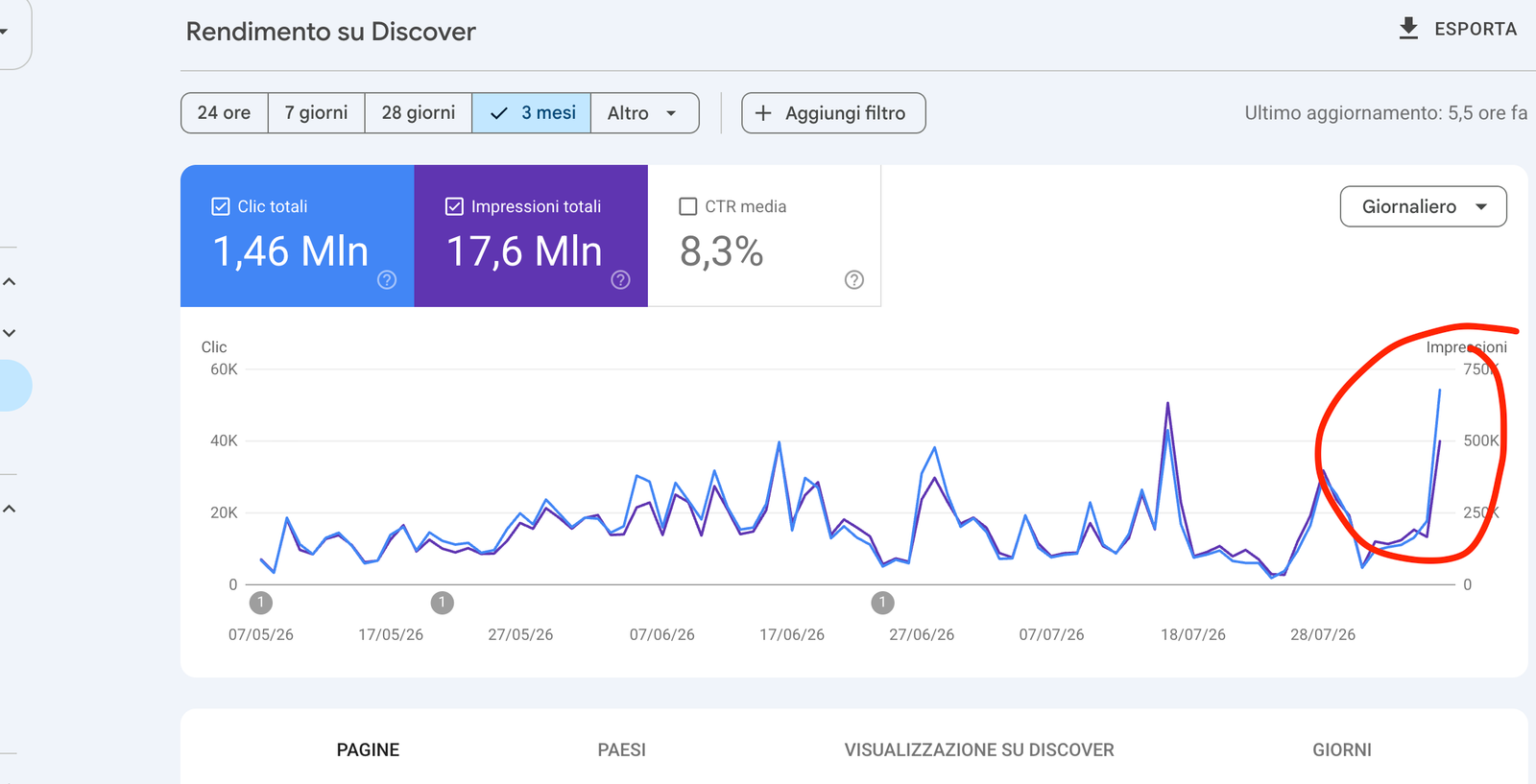
Google Search Console provides a Discover Performance report showing impressions, clicks and CTR for content that has appeared in Discover, subject to Google’s reporting thresholds.
Step 8: Analyze patterns
Do not focus only on individual articles.
Look for patterns across:
- Topics
- Headlines
- Images
- Publishing times
- Authors
- Categories
- Content formats
- CTR
- Impressions
Over time, this creates a proprietary understanding of what your audience and Google Discover appear to respond to.
Google Discover Optimization Is About Prediction, Not Just SEO
The future of Discover optimization is moving beyond traditional technical SEO.
The strongest publishers will combine SEO knowledge with trend detection, editorial judgment, audience intelligence and rapid publishing.
Google’s own 2026 guidance reinforces the importance of original, timely, in-depth content while reducing the value of sensationalism and clickbait.
That means the winning strategy is not simply:
“Publish more articles.”
It is:
“Identify the right story, at the right moment, with the right angle, and publish it better than competing publishers.”
This is where technology can provide a major advantage.
DiscoverPulse: Identify Stories Before They Enter Google Discover
For publishers serious about Google Discover, one of the biggest challenges is knowing which articles are beginning to show potential before they become visible everywhere in the Discover ecosystem.
This is where DiscoverPulse.it can become part of the workflow.
DiscoverPulse is designed to help publishers identify and monitor articles with the potential to enter Google Discover, giving them intelligence around emerging content opportunities.
Instead of relying exclusively on Search Console after traffic has already arrived, the goal is to move toward a more proactive approach:
Detect → Analyze → Publish → Monitor → Optimize.
For publishers, SEO professionals, media companies and website owners, this can transform Google Discover from a completely unpredictable traffic source into a more measurable editorial opportunity.
Discover will never be fully predictable—and Google itself confirms that Discover traffic naturally fluctuates.
But publishers can become better at identifying the conditions that create opportunities.
Google Discover optimization is no longer only about optimizing an article for Google. It is about understanding what people are likely to want next—and being ready before everyone else publishes it.